
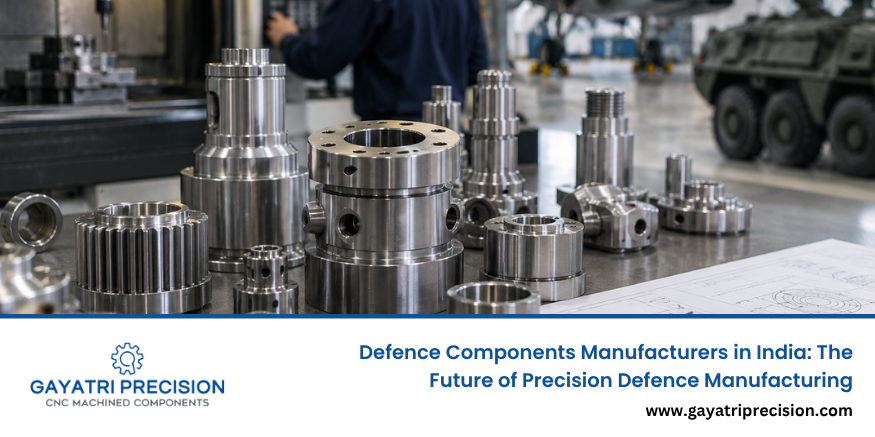
India’s defence manufacturing sector has evolved rapidly, driven by greater private sector participation and the country’s focus on self-reliance.
Today, defence components manufacturers in India play a critical role in producing precision-engineered parts that support military vehicles, aerospace systems, naval equipment, and other strategic applications.
Unlike conventional manufacturing, defence production demands exceptional accuracy, stringent quality control, complete material traceability, and strict compliance with industry standards.
Even the smallest component can influence the reliability, safety, and performance of an entire defence system. This makes engineering expertise and manufacturing discipline essential at every stage of production.
Companies like Gayatri Precision contribute to this growing ecosystem with advanced CNC machining, precision engineering, and consistent quality that meet the expectations of defence and allied aerospace sectors.
As India strengthens its domestic manufacturing capabilities, experienced defence components manufacturers continue to play a vital role in supporting innovation, national security, and long-term industrial growth.
Understanding the Defence Manufacturing Ecosystem
Defence manufacturing is not a single discipline but a convergence of several engineering competencies working in unison. It involves machining, fabrication, surface treatment, assembly, and rigorous testing, all governed by specifications that leave little room for deviation.
The components produced range from small precision fittings to structural assemblies used in land systems, naval platforms, and airborne equipment.
What separates this sector from general industrial manufacturing is the emphasis on:
- Absolute conformance to drawing specifications, often with tolerances measured in microns
- Material traceability from raw stock procurement through to final delivery
- Extensive documentation supporting every stage of production
- Compliance with defence-specific quality frameworks and inspection protocols
- The ability to work with specialised, often difficult-to-machine alloys
These requirements mean that not every manufacturer, however capable in commercial engineering, is equipped to serve this space. It takes years of process refinement, workforce training, and investment in appropriate infrastructure to earn credibility as a trusted supplier within defence supply chains.
Why India Needs a Strong Base of Domestic Manufacturers
For decades, India relied heavily on imports to meet a substantial portion of its defence equipment and component needs. This dependency carried strategic risks, including supply disruptions, extended procurement timelines, and limited control over technology access. The push toward indigenisation has therefore become a national priority, and it rests on the shoulders of capable domestic manufacturers who can step into roles once filled almost exclusively by foreign suppliers.
Defence engineering companies in India now play a central role in this shift, contributing to programmes spanning land, air, and naval platforms. Government initiatives promoting domestic sourcing, along with policy support for private sector participation, have created an environment where precision components manufacturers in India can scale their capabilities and take on increasingly complex work.
This transition benefits the nation in several ways:
- Reduced dependency on external suppliers for critical components
- Shorter lead times for procurement and maintenance requirements
- Greater control over intellectual property and technology retention
- Employment generation within a high-skill manufacturing segment
- Development of a robust supply chain capable of supporting future defence modernisation
The Overlap Between Defence and Aerospace Manufacturing
Defence and aerospace manufacturing rely on many of the same engineering principles, making it common for manufacturers to serve both sectors.
Experienced aerospace component manufacturers in India apply their expertise in precision machining, advanced materials, and quality assurance to defence applications with equal confidence.
Shared Manufacturing Requirements
Both industries require:
- Lightweight, high-strength materials for critical applications
- Tight dimensional tolerances and precision machining
- Comprehensive quality testing and full material traceability
- Compliance with strict industry and regulatory standards
A Strong Foundation for Growth
The overlap between these industries allows aerospace component manufacturers in India to efficiently support defence programmes using existing CNC infrastructure and proven manufacturing processes.
This shared capability strengthens India’s engineering ecosystem, reduces development costs, and enhances the country’s ability to deliver reliable, high-performance components for both commercial aerospace and national defence applications.
Materials and Machining Requirements in Defence Manufacturing
Defence applications frequently demand materials that perform reliably under extreme conditions, whether that means resisting corrosion in naval environments, withstanding high-impact loads in land systems, or maintaining structural integrity at the temperature extremes experienced in airborne platforms. Common materials used across this sector include:
- Titanium alloys: Valued for their exceptional strength-to-weight ratio, particularly in aerospace-linked defence applications
- High-strength stainless steel: Chosen for corrosion resistance and mechanical durability in demanding environments
- Aluminium alloys: Used where weight reduction is critical without compromising structural performance
- Nickel-based superalloys: Applied in components exposed to high thermal loads
- Specialised alloy steels: Selected for their toughness and fatigue resistance in structural and load-bearing parts
Machining these materials requires more than standard CNC capability. It demands an understanding of how each alloy behaves under cutting forces, appropriate tool selection to manage tool wear, and careful control of heat generation to avoid compromising material properties.
Manufacturers serving this space, including established military equipment parts manufacturers in India, must continually refine their machining parameters, often through trial validation and close collaboration with metallurgists, to consistently achieve the required outcomes.
Quality Standards and Certification in Defence Manufacturing
Perhaps no aspect of this sector receives more scrutiny than quality assurance. Given that defence components often support mission-critical or safety-critical functions, manufacturers must operate within frameworks considerably more rigorous than typical industrial standards. Key elements of a credible quality system in this space include:
- Certification aligned with aerospace and defence quality management standards
- Detailed first article inspection reports for every new component introduced
- Full material certification and batch traceability
- In-process inspection at defined checkpoints throughout production
- Final dimensional verification using coordinate measuring machines and advanced metrology tools
- Documented non-conformance and corrective action procedures
Military equipment parts manufacturers in India that succeed in this sector typically treat quality not as a final checkpoint but as a philosophy embedded throughout their operations. Every process, from incoming material inspection to final packaging, is designed to eliminate variability and ensure that each component performs exactly as specified, without exception.
This uncompromising approach to quality is precisely what separates dependable partners from those unable to sustain long-term relationships with defence programme stakeholders. Trust in this sector is earned slowly, through consistent, defect-free delivery over extended periods, and lost quickly if standards slip even once.
Capabilities Required of a Serious Defence Manufacturing Partner
Manufacturers seeking to establish themselves as credible defence-focused precision suppliers must demonstrate a combination of technical, operational, and cultural attributes. These typically include:
- Advanced machining infrastructure: Multi-axis CNC turning and milling capability suited to complex geometries and difficult materials
- Skilled workforce: Engineers and machinists experienced in reading complex technical drawings and working to tight tolerances
- Process documentation discipline: A culture of thorough record-keeping that supports full traceability
- Metrology and inspection capacity: In-house equipment capable of verifying compliance without relying entirely on external testing
- Confidentiality and security awareness: An understanding of the sensitivity surrounding defence-related projects and information handling
- Consistency across production volumes: The ability to maintain identical quality whether producing a handful of prototype parts or a larger production batch
Manufacturers who combine these attributes position themselves well to support the growing pipeline of indigenisation programmes across land, air, and naval defence platforms.
What Sets Gayatri Precision Apart in This Sector
Gayatri Precision, a trusted CNC machined components supplier, combines advanced manufacturing capabilities with an engineering-driven approach to deliver reliable, high-quality components for precision-critical industries.
With extensive experience supporting aerospace applications, the company is well-positioned to meet the exacting standards expected by defence engineering companies in India. Every project is approached with a focus on precision, material performance, and long-term reliability rather than simply producing parts to specification.
Core Strengths
Gayatri Precision stands out through:
- Quality-focused manufacturing with rigorous inspection at every production stage
- Advanced CNC turning and precision machining backed by skilled technical professionals
- Expertise in specialised materials used across defence and aerospace applications
- Complete documentation and traceability to support industry-specific compliance requirements
- Collaborative engineering support that transforms complex designs into efficient, repeatable manufacturing processes
A Trusted Manufacturing Partner
By offering end-to-end machining solutions under one roof, Gayatri Precision simplifies procurement, improves production efficiency, and strengthens supply chain reliability. This integrated approach enables clients to source multiple precision components from a single trusted partner.
As one of the dependable defence engineering companies in India, Gayatri Precision continues to support the country’s vision of self-reliant defence manufacturing through consistent quality, technical expertise, and precision engineering excellence.
Challenges Facing the Sector
Despite significant progress, defence component manufacturing in India continues to navigate certain challenges that shape how the sector develops. These include:
- Skill availability: Finding and retaining machinists and engineers experienced in defence-grade tolerances and materials remains an ongoing effort
- Capital intensity: Advanced CNC machinery, metrology equipment, and certification processes require substantial upfront investment
- Certification timelines: Achieving and maintaining the necessary quality certifications can be a lengthy, resource-intensive process
- Technology transfer complexity: Absorbing advanced manufacturing techniques for newer alloys and geometries takes sustained learning and adaptation
- Long qualification cycles: Defence programmes often require extended validation periods before a new supplier is fully approved
Manufacturers who navigate these challenges successfully, investing steadily in infrastructure and workforce capability, are the ones best positioned to grow alongside India’s expanding defence production requirements.
The Road Ahead for Defence Manufacturing in India
The trajectory for this sector points firmly toward expansion. Government policy continues to favour domestic sourcing, indigenisation targets are becoming more ambitious, and private manufacturers are increasingly trusted with components that were once the exclusive domain of established public sector entities. This shift is expected to accelerate as more manufacturers achieve the certifications and operational maturity required to participate meaningfully in defence supply chains.
Emerging areas of growth include unmanned systems, advanced naval platforms, and next-generation land systems, each of which will require precision components manufactured to increasingly exacting standards. Manufacturers who continue investing in technology, talent, and quality systems today are effectively positioning themselves to be central contributors to India’s defence manufacturing story over the coming decade.
Partner with Gayatri Precision for Trusted Defence Manufacturing
As one of the reliable defence components manufacturers in India, Gayatri Precision is committed to delivering precision-engineered components that meet the highest standards of quality, accuracy, and performance.
Backed by advanced CNC machining, skilled engineering expertise, and strict quality control processes, the company ranks among the top turned components manufacturers supporting defence and aerospace projects with dependable manufacturing solutions.
Whether you require custom-machined parts, high-precision components, or a trusted long-term production partner, Gayatri Precision provides consistent quality and timely delivery.
Contact our team today to discuss your project requirements and discover how our precision engineering capabilities can help strengthen your defence manufacturing supply chain with confidence.
Frequently Asked Questions About Defence Components
- What qualities distinguish reliable defence-grade precision manufacturers from general industrial suppliers?
Reliable defence manufacturers demonstrate strict adherence to drawing specifications, comprehensive material traceability, robust documentation practices, and certifications aligned with defence and aerospace quality standards. They also maintain consistency across production volumes and understand the confidentiality expectations associated with defence-related projects.
- Why is there significant overlap between defence and aerospace component manufacturing?
Both sectors demand similar levels of precision, use comparable high-performance materials, and require stringent testing and documentation protocols. As a result, many aerospace component manufacturers in India naturally extend their capabilities into defence work, applying established quality systems to related applications such as airborne defence platforms and unmanned systems.
- What materials are commonly used by military equipment parts manufacturers in India?
Common materials include titanium alloys, high-strength stainless steel, aluminium alloys, nickel-based superalloys, and specialised alloy steels. Material selection depends on the specific application, considering factors such as strength-to-weight ratio, corrosion resistance, and performance under extreme thermal or mechanical conditions.
- How do defence engineering companies in India ensure consistent quality across production batches?
Consistent quality is achieved through structured processes including incoming material verification, in-process inspection checkpoints, first article inspection reports, and final dimensional checks using advanced metrology equipment. Certification against recognised quality management frameworks and thorough documentation further reinforce reliability across every production batch.