
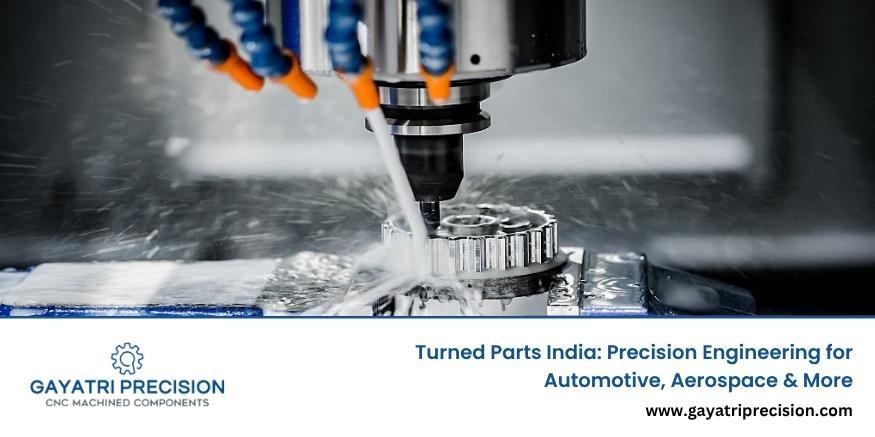
India’s manufacturing landscape has grown into a dependable hub for high-precision components that power industries across the globe.
Among the many manufacturing disciplines that have matured over the last two decades, the production of turned parts in India stands out as a segment defined by accuracy, consistency, and engineering discipline.
From automotive assemblies to aerospace mechanisms, hydraulic systems to general engineering applications, turned components form the quiet backbone of countless machines that keep industries running smoothly.
This growth has not happened by accident. It is the outcome of sustained investment in machinery, skilled workforce development, stringent quality practices, and a deep understanding of customer requirements across sectors.
Companies such as Gayatri Precision have played a meaningful role in shaping this narrative, offering a wide spectrum of turning and machining capabilities that cater to demanding industries where tolerances are measured in microns and failure is simply not an option.
In this blog, we take a closer look at what turned parts really are, why precision matters so much in their production, the industries that rely on them, and what sets a dependable manufacturing partner apart in this competitive space.
Understanding Turned Parts and Why They Matter
Turned parts are components manufactured using a lathe or CNC turning centre, where a rotating workpiece is shaped by a stationary or moving cutting tool. This process removes material layer by layer until the desired diameter, contour, thread, or profile is achieved. The result is a cylindrical or symmetrical component with dimensional accuracy that few other manufacturing methods can match.
Common outputs of this process include:
● Shafts, spindles, and axles used in rotating assemblies
● Bushings, sleeves, and bearing housings
● Pins, studs, and fasteners for structural joining
● Connectors and fittings for fluid or electrical systems
● Spacers and precision washers requiring tight axial control
What makes turning particularly valuable is its ability to deliver tight tolerances, smooth surface finishes, and repeatable accuracy across large production runs, which is exactly what modern industries demand.
As global supply chains diversify and companies look for reliable alternatives to traditional manufacturing hubs, precision turned components in India have gained significant traction. Indian manufacturers combine cost efficiency with technical competence, offering international clients a compelling value proposition without compromising on quality benchmarks.
The Shift Toward CNC Turning
Traditional manual lathes once dominated the turning landscape, but the industry has decisively moved toward Computer Numerical Control, or CNC, technology. This shift has redefined what precision manufacturing looks like in India.
A CNC turned parts manufacturer in India today operates advanced multi-axis machines capable of producing complex geometries with minimal human intervention, reducing errors and enhancing repeatability across thousands of components.
Key advantages of CNC turning over conventional methods include:
● Repeatability: Programs are written once and executed indefinitely, so the thousandth part matches the first
● Multi-operation capability: Multi-spindle and multi-axis machines combine turning, milling, drilling, and threading in a single setup
● Reduced cycle time: Simultaneous operations shorten production timelines considerably
● Lower material wastage: Precise programming minimises scrap, especially valuable with costly aerospace-grade alloys
● Consistent quality: Automated control eliminates variability associated with manual operator technique
Facilities equipped with modern CNC infrastructure, in-house tooling capability, and skilled programmers are what differentiate a competent CNC turned parts manufacturer in India from a merely adequate one.
The combination of machine precision and human expertise in process planning is what ultimately determines the quality of the final component.
Industries Powered by Turned Components
Automotive Sector
The automotive industry remains one of the largest consumers of turned components globally, and India’s automotive manufacturing base has grown substantially to support this demand. Typical applications include:
● Engine parts such as pins, bushes, and small shafts
● Transmission shafts and gear-related components
● Steering system components requiring high fatigue resistance
● Brake system parts subject to thermal and mechanical stress
● Suspension elements that must withstand continuous vibration
Given the scale of vehicle production, automotive clients require suppliers who can maintain consistency across high-volume orders while adhering to strict quality protocols such as IATF standards.
This is where established turned components suppliers in India bring real value, offering the capacity, process control, and traceability that automotive original equipment manufacturers and tier suppliers expect.
Aerospace Sector
Aerospace applications represent perhaps the most demanding end of the spectrum. Components used in aircraft structures, engines, and control systems must meet exceptionally tight tolerances, often in the range of a few microns, while being manufactured from difficult-to-machine materials such as titanium, Inconel, and high-strength stainless steel.
Manufacturers serving this sector are expected to demonstrate:
● Documented process control at every production stage
● Full material traceability from raw stock to finished part
● Advanced metrology equipment for micron-level inspection
● Specific certifications validating capability for safety-critical work
● A consistent, defect-free delivery record built over years
Hydraulics and Pneumatics
Hydraulic and pneumatic systems depend heavily on turned parts such as:
● Pistons and piston rods
● Cylinder liners and sleeves
● Connectors requiring leak-proof sealing under high pressure
Even minute deviations in roundness or surface finish can lead to seal failure, making dimensional precision non-negotiable in this domain.
General Engineering and Industrial Machinery
Beyond automotive and aerospace, turned components find extensive use in:
● Textile machinery components
● Agricultural equipment parts
● Pumps and valves
● Industrial automation systems
The versatility of turning as a process means that virtually any sector requiring rotationally symmetric metal parts can benefit from it.
Electrical and Electronics
Connectors, terminals, and precision fittings used in electrical assemblies also rely on turned manufacturing, particularly when miniaturisation and dimensional consistency are essential for proper fit and function within larger assemblies.
Materials Used in Precision Turning
Leading turned components manufacturers work with a wide range of metals to meet the performance, durability, and compliance requirements of different industries. The choice of material directly influences a component’s strength, corrosion resistance, machinability, and overall service life.
Experienced manufacturers understand how each material responds during machining and optimise CNC parameters to achieve tight tolerances and superior surface finishes.
Common Materials Used for Turned Components
● Mild Steel: A cost-effective option widely used for general engineering, industrial machinery, and structural applications.
● Stainless Steel: Known for excellent corrosion resistance, making it ideal for automotive, hydraulic, food processing, and medical components.
● Brass: Highly machinable with excellent electrical conductivity, making it suitable for electrical fittings, valves, and plumbing parts.
● Aluminium: Lightweight yet strong, commonly used in aerospace, automotive, and electronics where reducing weight is essential.
● Alloy Steel and Specialised Alloys: Designed for demanding applications requiring exceptional strength, wear resistance, and heat tolerance, particularly in aerospace, defence, and heavy engineering.
Why Material Expertise Matters
Every material requires different cutting speeds, tooling, coolant strategies, and machining techniques to maintain dimensional accuracy and production efficiency.
Turned components suppliers in India combine material knowledge with advanced CNC technology to deliver consistent quality across diverse applications. Their expertise ensures reliable performance, reduced production defects, and components that meet the exact specifications of modern manufacturing industries.
Quality Assurance: The Non-Negotiable Element
Precision manufacturing is inseparable from quality assurance. A component that looks correct to the naked eye can still fall outside acceptable tolerance, which is why robust inspection processes are built into every stage of production. Key elements of a strong quality framework include:
● Incoming raw material verification before production begins
● In-process dimensional checks at defined intervals
● Final inspection using coordinate measuring machines and profile projectors
● First article inspection reports for new components
● Material certificates and process control documentation
● Certifications aligned with international quality management systems
This emphasis on quality is precisely why precision turned components in India have earned trust among global buyers.
It is not simply about producing a part that fits; it is about producing a part that performs reliably for its entire intended service life, batch after batch, year after year.
What Sets Gayatri Precision Apart
Within this competitive landscape, Gayatri Precision has positioned itself as a manufacturer that understands the nuanced requirements of diverse industries.
Rather than offering a generic machining service, the company approaches each project with an engineering mindset, evaluating component design, material behaviour, and functional requirements before finalising the manufacturing process.
Notable strengths include:
● Integrated offerings: CNC turning, precision machining, and allied processes under one roof, allowing clients to source multiple part types from a single, dependable partner
● Cross-industry experience: Serving automotive, aerospace, hydraulics, and general engineering sectors, each with distinct inspection and process requirements
● Operational maturity: A clear understanding that, for instance, an aerospace bracket demands a different inspection regime than an automotive bushing
● Modern infrastructure: Advanced CNC machines paired with skilled operators
● Quality-first philosophy: Process discipline embedded at every stage rather than relying on inspection alone
This combination of technical capability and industry understanding is what makes the company a credible name among turned components suppliers in India.
Why Global and Domestic Buyers Choose Indian Manufacturers
The appeal of sourcing precision components from Indian manufacturers extends beyond cost advantages alone, though competitive pricing remains an important factor. Additional reasons buyers continue to choose Indian suppliers include:
● Skilled engineering talent combined with growing technological sophistication
● Flexibility in handling both small prototype batches and large-scale production runs
● Strategic geographic position and improving logistics infrastructure for global integration
● A stable, quality-conscious alternative for companies diversifying away from concentrated sourcing regions
● Shorter lead times and easier communication for domestic buyers
● Greater ease of conducting in-person audits and factory visits
A reliable CNC turned parts manufacturer in India therefore offers both export-ready capability and dependable local partnership, a dual appeal that has fuelled steady growth in India’s precision component manufacturing sector.
The Road Ahead for Precision Turning in India
Looking forward, the demand for precision turned components in India is expected to keep climbing, driven by several converging trends:
● Expanding automotive electrification requiring new component designs
● Growing aerospace and defence indigenisation efforts
● The broader push toward domestic manufacturing self-reliance
● Rising complexity in component requirements, including tighter tolerances and exotic materials
● Increasing pressure for faster turnaround times without compromising accuracy
Manufacturers who invest continuously in technology upgrades, workforce training, and quality systems will be best positioned to meet this evolving demand.
The companies that succeed will not be those offering the lowest price alone, but those capable of consistently delivering engineering value, reliability, and long-term partnership to their clients.
Partner with Gayatri Precision for High-Quality Turned Parts
When precision, consistency, and reliability matter, Gayatri Precision delivers turned parts that meet the exacting standards of industries across India and beyond.
With advanced CNC machining, strict quality control, and years of manufacturing expertise, the company produces components designed for performance and long-term durability.
Whether you need custom-turned parts for automotive, aerospace, engineering, or industrial applications, Gayatri Precision offers dependable solutions tailored to your specifications.
Get in touch with our team today to discuss your project, request a quote, and discover how our precision manufacturing capabilities can support your business with quality components delivered on time, every time.
Frequently Asked Questions About Turned Parts in India
1. What industries typically require precision-turned components manufactured domestically?
Turned components are widely used across automotive, aerospace, hydraulics and pneumatics, general engineering, and electrical and electronics industries. Each sector has distinct tolerance, material, and finish requirements, which experienced manufacturers accommodate through tailored process planning.
2. How is CNC turning different from conventional turning methods?
CNC turning uses computer-controlled machines to produce highly accurate and consistent components with tight tolerances. Compared to manual turning, it offers faster production, greater repeatability, and the ability to manufacture complex parts efficiently, making it the preferred choice for high-volume precision manufacturing.
3. What materials can be processed for precision turned components?
A capable manufacturer typically works with a wide range of materials, including mild steel, stainless steel, brass, aluminium, and specialised alloys. Material selection depends on the application’s mechanical, thermal, and environmental requirements, and each material demands specific machining parameters for optimal results.
4. How do I choose a reliable manufacturer among turned components suppliers in India?
Look for manufacturers with proven cross-industry experience, robust quality management systems, modern CNC infrastructure, and transparent communication practices. Reviewing certifications, requesting sample inspection reports, and understanding their approach to process documentation can help gauge whether a supplier is equipped to meet your specific component requirements consistently.